A customer likes your product, agrees with the price and is ready to place an order. Then they see the delivery fee and suddenly stop responding.
For many businesses, delivery charges are one of the biggest reasons customers abandon an order. Some buyers feel the fee is too high, while business owners worry that reducing it will destroy their profit.
The solution is not to offer the cheapest delivery possible. It is to create a fair and transparent pricing system that customers can understand.
Services You May Like
When delivery charges are properly calculated and clearly explained, customers are more likely to accept them without arguments. Your business also avoids paying part of the delivery cost from its own profit.
Know the Real Cost of Each Delivery
Before setting a delivery fee, understand what the delivery actually costs.
The amount may depend on:
1. Pickup location
2. Customer’s destination
3. Travel distance
4. Package size and weight
5. Delivery speed
6. Traffic conditions
7. Number of stops
8. Special handling requirements
A small parcel going to a nearby location should not necessarily attract the same fee as a large or fragile product travelling across the city.
Do not guess your delivery charges or copy another business without understanding its logistics arrangement. Their costs, products and customer locations may be completely different from yours.
Once the order details have been confirmed, you can book a delivery through AllDeliveries and determine the most suitable delivery option.
Avoid Hiding Delivery Charges
Customers dislike unexpected costs.
If a customer only discovers the delivery fee after spending time selecting products and completing an order, they may feel misled.
Where possible, provide delivery information early. You can display:
1. Starting delivery fees
2. Delivery zones
3. Same-day and next-day options
4. Nationwide delivery estimates
5. Extra charges for large or fragile items
The final amount may still depend on the exact address, but customers should have a reasonable idea before reaching the payment stage.
Transparent pricing also supports the trust-building principles explained in how to build customer trust before the first delivery.
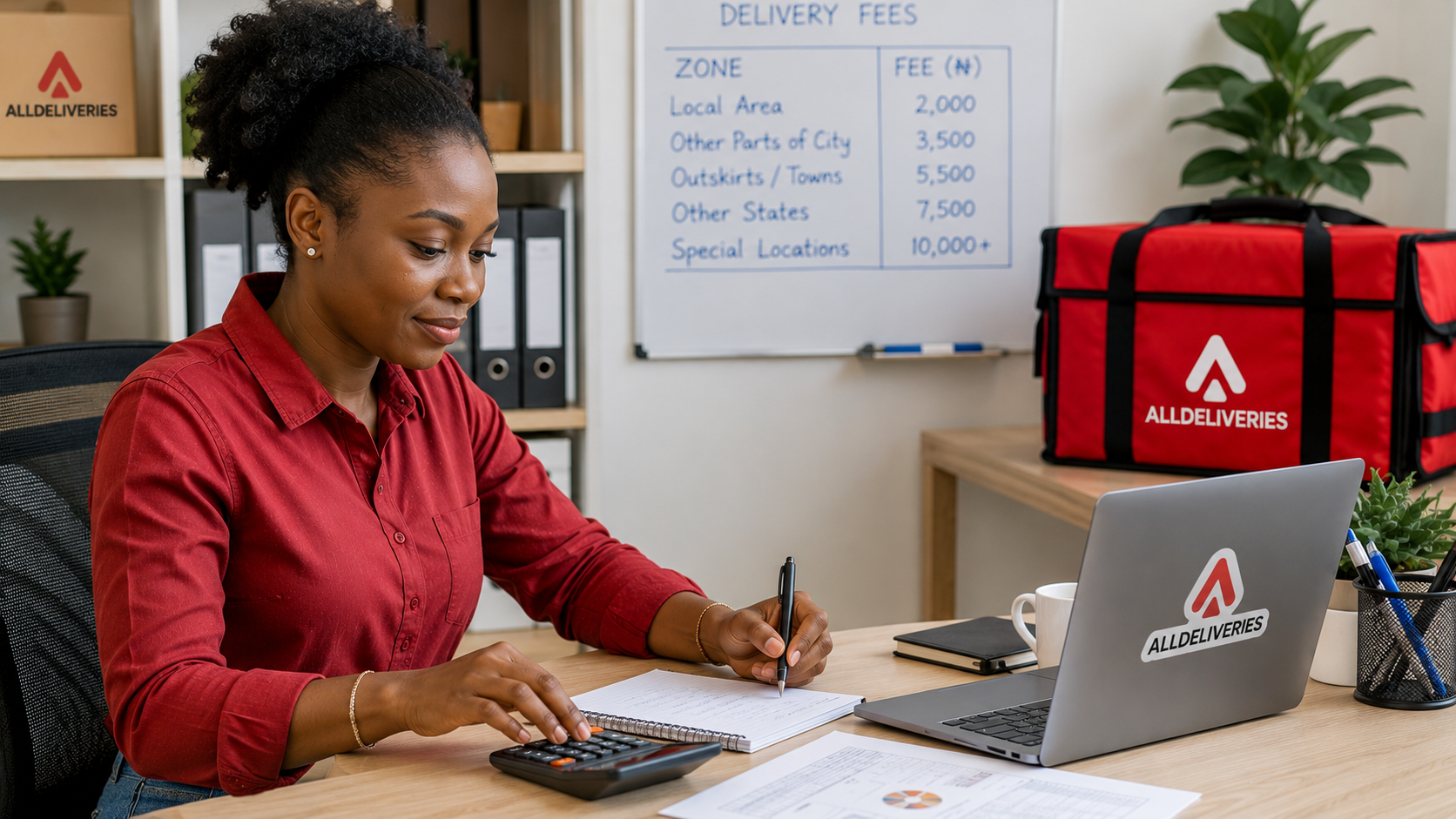
Create Simple Delivery Zones
A delivery-zone system can make pricing easier for both your team and customers.
For example, you may group locations into:
1. Nearby areas
2. Other parts of the city
3. Surrounding towns
4. Other states
5. Special or remote locations
Each zone can have a standard starting fee, with adjustments for product size, urgency or special handling.
This prevents staff members from giving different prices to customers in the same area. It also makes your business appear more organised.
Review your actual delivery records regularly to confirm that each zone remains profitable. The advice in how delivery records can help your business grow can help you identify where costs are increasing.
Offer Customers More Than One Delivery Option
Not every customer needs urgent delivery.
Some buyers will gladly wait until the next day if it means paying a lower delivery fee. Others may be willing to pay more for same-day or express delivery.
Where practical, offer options such as:
1. Standard delivery
2. Next-day delivery
3. Same-day delivery
4. Scheduled delivery
5. Express delivery
This gives customers more control instead of forcing everyone to pay for the fastest service.
Our guide on same-day versus next-day delivery can help you decide which options are suitable for your products.
Explain What the Delivery Fee Covers
Some customers think the delivery fee is extra profit for the seller.
A simple explanation can reduce arguments.
Let customers know that the fee covers the transportation and handling required to move the parcel safely from your business to their location. Where the order is fragile, bulky, urgent or going to a restricted-access location, explain why the cost may be higher.
Avoid sounding defensive. Keep the explanation short and professional.
For example: “The delivery fee is based on your location and the size of the package. It covers direct pickup and delivery to your address.”
Customers are more likely to accept a charge when they understand how it was calculated.
Decide When to Offer Free Delivery
Free delivery can attract customers, but it should not be offered carelessly.
The business still pays for the delivery even when the customer does not.
Free delivery may work when:
1. The order reaches a minimum value
2. The customer is within a nearby area
3. Several orders are going to the same location
4. It is part of a limited promotion
5. The delivery cost has already been included in the product price
Before launching a free-delivery campaign, calculate whether the expected sales and profit can cover the logistics cost.
Offering free delivery on low-value orders may increase sales while reducing actual profit.
Reduce Costs Before Reducing Fees
If customers regularly complain about your delivery charges, investigate the delivery process before simply lowering the price.
You may be able to reduce expenses by:
1. Grouping nearby deliveries
2. Confirming addresses before dispatch
3. Avoiding failed delivery attempts
4. Using appropriately sized packaging
5. Scheduling flexible orders together
6. Selecting the correct vehicle for each parcel
Our article on how to reduce delivery costs without losing customers explains how to improve efficiency without damaging service quality.
Lower operational costs allow you to offer fairer fees without sacrificing profit.
Include Delivery Charges in Your Policy
Your delivery policy should explain:
1. How fees are calculated
2. When additional charges may apply
3. Who pays for redelivery
4. Whether delivery fees are refundable
5. When free delivery is available
6. What happens after a failed attempt
These rules should be available before the customer pays.
A clear delivery policy customers can understand prevents arguments and gives your team a consistent process to follow.
Make Your Delivery Fees Fair and Sustainable
The best delivery fee is not always the lowest one.
It should be affordable enough for customers, but high enough to cover the real cost of completing the delivery properly.
Calculate carefully, explain the fee clearly and give customers suitable options where possible. A transparent pricing system protects your profit while helping customers feel confident about completing their orders.
You can also download the AllDeliveries mobile app to arrange deliveries conveniently from your phone.
For more practical logistics and business-growth advice, visit the AllDeliveries Blog.
Frequently Asked Questions
How should a business calculate delivery fees?
Consider the distance, location, package size, urgency, vehicle required and any special handling needs.
Should every customer pay the same delivery fee?
Not necessarily. Charges may vary depending on the destination and type of order.
Is free delivery really free?
No. The business still pays the logistics cost, so it should only be offered when the sale can cover it.
Why do customers complain about delivery charges?
Complaints often happen when fees are unexpected, poorly explained or appear too high compared with the product value.
Can customers be offered different delivery options?
Yes. Standard, next-day, same-day and express options allow customers to choose based on their budget and urgency.
Comments
No comments yet. Be the first to comment.